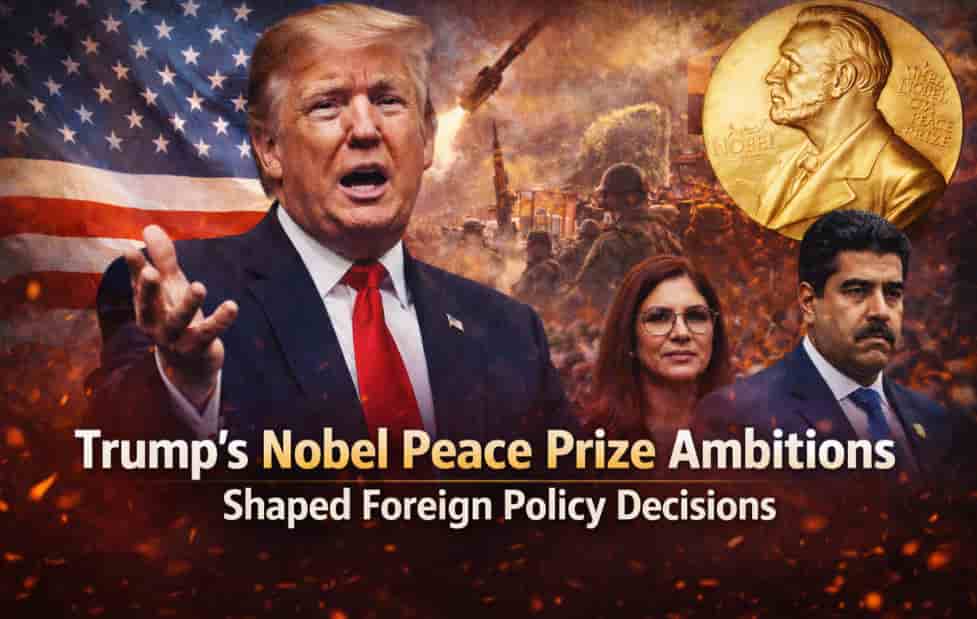
Former United States President Donald Trump’s long standing desire to receive a Nobel Peace Prize appears to have played a significant role in shaping his foreign policy decisions. Observers note that this ambition influenced how he approached diplomacy and global conflicts, with actions and rhetoric stretching from South Asia to Latin America. For Trump, the idea of leaving behind a peace focused legacy often seemed to guide how major international decisions were framed and communicated.
Trump has openly spoken about his admiration for Nobel Peace Prize winners and has repeatedly expressed frustration that his own efforts have not been similarly recognized. This aspiration influenced the way he presented international challenges, including trade talks with countries like India and responses to geopolitical tensions elsewhere. At several points, he suggested that achieving global peace and stability through his leadership would strengthen his reputation on the world stage.
One notable example often cited by analysts relates to developments in Venezuela. Following American involvement that led to the capture of Venezuelan leader Nicolás Maduro and his wife, the administration pushed for a carefully managed transition of power. Rather than endorsing immediate and sweeping political changes, Trump’s approach remained cautious. Some observers believe this restraint was intended to frame American actions as peace driven rather than aggressive regime change.
Despite the dramatic developments in Venezuela, Trump did not immediately support María Corina Machado as a replacement leader, even though she had strong democratic credentials. This decision surprised several international observers. Critics argued that Trump’s hesitation reflected a concern about maintaining his image as a peace focused leader, even if it meant delaying decisive political support.
Trumps focus on legacy extended beyond Venezuela. His broader foreign policy often emphasized themes of stability dialogue and conflict resolution. Official messaging frequently highlighted peace and negotiation, even when policies involved military pressure or economic sanctions. This approach allowed controversial decisions to be presented within a narrative of maintaining global order.
However critics argue that this strategy sometimes resulted in mixed signals. While peace was emphasized in speeches and statements, simultaneous military actions and sanctions created contradictions. This tension highlighted the challenge of balancing short term strategic interests with the pursuit of a long term peace oriented legacy.
Supporters of Trump’s approach argue that his efforts helped reduce certain conflicts and deserved recognition. Others caution that global peace awards are rarely granted based on ambition alone and require consistent and principled diplomacy.
As 2026 progresses, Trump’s pursuit of a peace legacy continues to shape how his foreign policy record is viewed. The debate remains whether these actions were driven more by personal ambition or genuine efforts to promote peace on the global stage.