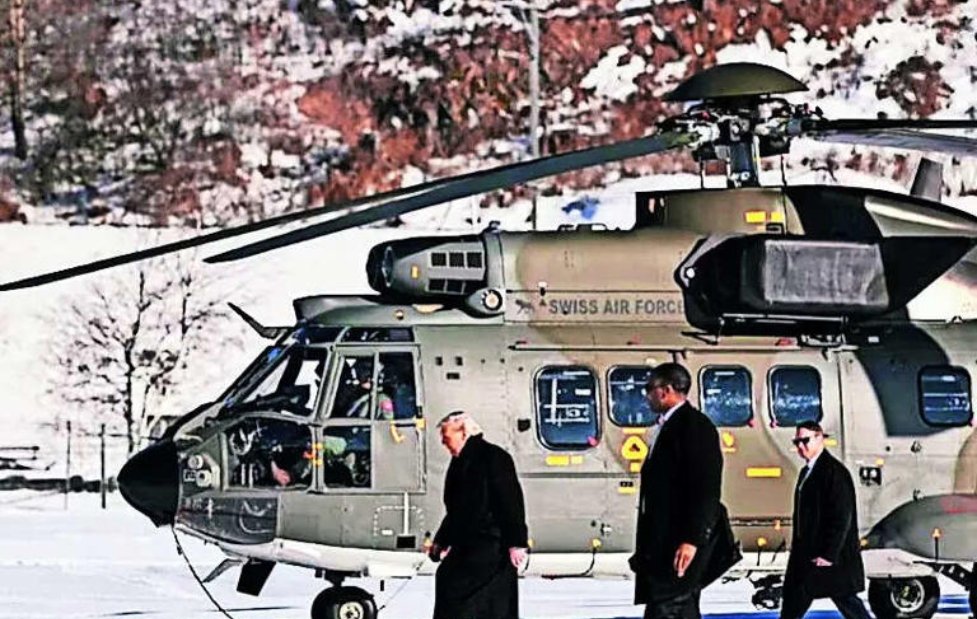
Davos: A Stage of Confidence, Not Reality
Every January, the World Economic Forum in Davos projects an image of global unity—world leaders exchanging handshakes, CEOs predicting growth, and panels promising solutions to humanity’s biggest problems. Yet beneath the polished speeches and private jets lies an uncomfortable truth: the United States, once the anchor of the global order, appears to be voluntarily winding itself down.
While American representatives still dominate conversations, their influence increasingly feels symbolic rather than strategic. Davos may sparkle, but it cannot conceal a deeper geopolitical shift underway.
A Retreat Chosen, Not Forced
America’s current position is not the result of military defeat or economic collapse. It is a conscious political choice.
Across administrations, Washington has steadily reduced its appetite for global leadership:
- Retreat from long-term military commitments
- Reluctance to underwrite global security guarantees
- Growing hostility toward multilateral institutions
- Preference for transactional diplomacy over alliances
This is not isolationism in the traditional sense. It is something subtler a narrowing of ambition.
The message to the world is increasingly clear: America wants influence without obligation.
Davos Speeches vs Policy Reality
At Davos, American officials speak of democracy, stability, and global cooperation. But outside the Alpine resort, policy decisions tell a different story.
- Allies face uncertainty over U.S. security commitments
- Trade partnerships remain fragile and unpredictable
- Climate leadership fluctuates with domestic politics
- International institutions face funding fatigue
This contradiction undermines credibility. Leadership cannot be switched on for speeches and off for governance.
The Cost of Strategic Inwardness
America’s partial withdrawal leaves behind power vacuums and history shows such spaces never remain empty.
As Washington hesitates:
- China expands economic and technological influence
- Russia tests borders and norms
- Middle powers form regional blocs
- Europe scrambles to build strategic autonomy
The result is not stability but fragmentation.
Without a coordinating power, global systems from trade to security become transactional, reactive, and brittle.
Europe’s Growing Anxiety
Nowhere is this shift felt more sharply than in Europe.
For decades, European security rested on a simple assumption: the U.S. would always be there. That certainty is gone.
From Ukraine to the Arctic, European leaders increasingly ask:
- Will America stay engaged long term?
- Or only when its domestic politics allow?
Davos conversations reflect this unease. Behind closed doors, European officials discuss defense spending, independent capabilities, and reduced dependence on Washington—not because they want separation, but because uncertainty leaves no choice.
The Domestic Pull That Shapes Foreign Policy
America’s inward turn is deeply rooted in domestic politics.
Rising inequality, political polarization, immigration debates, and economic insecurity have reshaped voter priorities. Foreign policy now struggles to compete with internal anxieties.
Global leadership is expensive financially and politically. Voters increasingly ask what they gain from it. As a result, presidents of both parties frame international engagement defensively rather than aspirationally. The world is no longer something to shape only something to manage.
Davos as a Mask
This is why Davos feels increasingly disconnected from reality.
The panels talk about global cooperation.
Markets talk about de-risking.
Governments talk about national resilience.
The language of globalization survives, but its architecture weakens.
Davos has become less a command center of the world and more a networking summit for a system slowly losing its anchor.
What America Is Losing
The retreat carries consequences that extend beyond geopolitics.
By stepping back, the U.S. risks losing:
- Agenda-setting power
- Moral authority
- Institutional influence
- Long-term economic leverage
Leadership, once surrendered, is difficult to reclaim.
Soft power erodes quietly. Influence fades gradually. And by the time its absence is felt fully, alternatives have already taken root.
A World Adjusting Without Washington
The most telling sign of America’s winding down is not criticism but adaptation.
Countries are no longer waiting for U.S. direction. They are planning around its unpredictability.
From energy corridors to defense cooperation, nations are building parallel systems designed to function whether America leads or not.
That adjustment, once unthinkable, is now mainstream.
The End of Illusion
The glitz and grandeur of Davos cannot mask a fundamental shift.
America is not collapsing.
It is choosing limitation over leadership.
Whether this retreat proves temporary or permanent will shape the next global order. But for now, the message from the world’s most powerful democracy is unmistakable: it no longer wishes to carry the weight it once insisted upon bearing. Davos can celebrate optimism. Markets can applaud stability. But history notices absences more than speeches.
And America’s absence gradual, voluntary, and unfinished may define this decade more than any summit ever could.