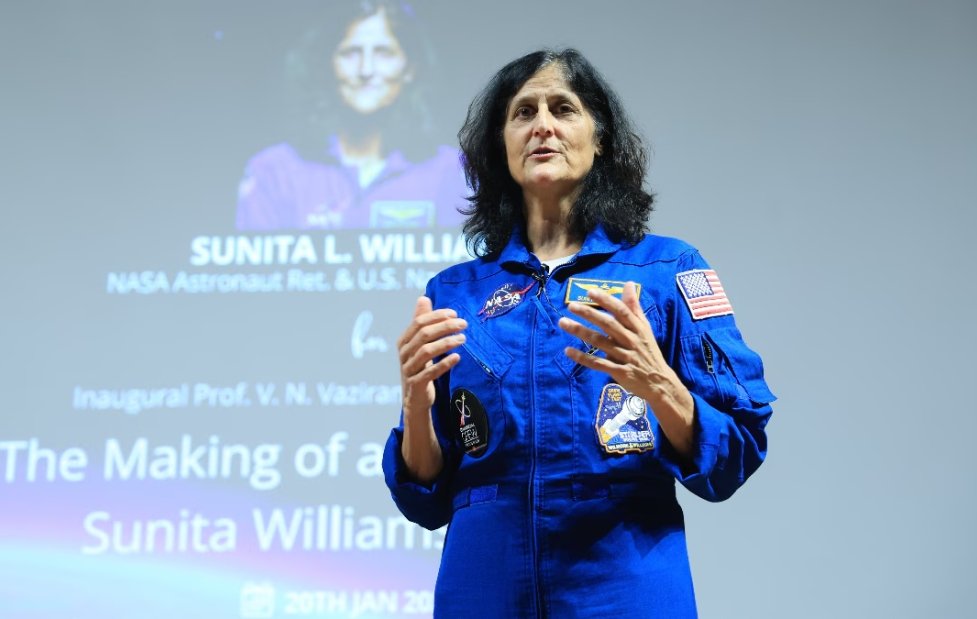
A Historic Farewell to Space
Veteran NASA astronaut Sunita Williams, one of the most respected faces of human spaceflight, has officially retired—bringing renewed attention to one of the most dramatic chapters of her career: the time she was unexpectedly stuck in space for nearly nine months.
What was supposed to be a short-duration test mission turned into a prolonged stay aboard the International Space Station (ISS), testing not only engineering systems but human endurance, mission planning, and international cooperation in space.
As tributes pour in following her retirement, many are asking: What exactly went wrong and how did Sunita Williams survive nine unplanned months in orbit?
The Mission That Was Never Meant to Last
In June 2024, Sunita Williams and fellow astronaut Butch Wilmore launched aboard Boeing’s Starliner spacecraft on its first crewed test flight.
The original plan:
Mission duration: 8–10 days
Objective: certify Starliner for future astronaut transport
Return: onboard the same spacecraft
But things didn’t go according to plan.
What Went Wrong With Boeing’s Starliner?
- Soon after docking with the ISS, engineers detected multiple technical failures, including:
- Helium leaks in propulsion systems
- Thruster malfunctions affecting maneuverability
- Concerns over safe re-entry performance
- NASA and Boeing jointly concluded that returning astronauts in the same spacecraft could be unsafe.
As a result:
Starliner returned to Earth uncrewed
Williams and Wilmore were told to remain on the ISS indefinitely
What began as a test mission became an unplanned long-duration space stay.
How Long Were They Actually Stuck?
Planned stay: ~10 days
Actual stay: nearly 9 months
Duration in orbit: approximately 270 days
The astronauts had no fixed return date for months, depending entirely on future mission scheduling and spacecraft availability.
Life Aboard the ISS During the Extended Stay
Despite the uncertainty, Williams remained fully active.
Her responsibilities included:
- Conducting scientific experiments
- Maintaining ISS systems
- Participating in international crew operations
- Performing spacewalk preparations
- Assisting arriving and departing missions
- NASA officials repeatedly emphasized that there was no immediate danger, but the psychological strain of an undefined mission timeline was significant.
- Physical and Mental Challenges of Prolonged Spaceflight
Spending nine months in microgravity comes with serious health risks:
- Muscle atrophy
- Bone density loss
- Vision changes
- Fluid redistribution affecting the heart
- Sleep disruption
- Isolation-related mental stress
Sunita Williams followed strict countermeasures:
- Two hours of daily exercise
- Resistance and treadmill training
- Monitored nutrition
- Continuous medical tracking
- NASA later confirmed both astronauts remained medically stable throughout the mission.
How Did She Finally Return to Earth?
NASA ultimately arranged their return via a SpaceX Crew Dragon mission, after ensuring seat availability and mission compatibility.
In early 2025:
- Williams and Wilmore boarded the Dragon capsule
- Successfully re-entered Earth’s atmosphere
- Landed safely after months of delay
- The incident quietly marked one of the longest unintended space stays in modern astronaut history.
- Why This Mission Changed NASA’s Space Strategy
The episode had far-reaching implications:
- Raised serious questions about Boeing Starliner reliability
- Delayed Starliner’s operational certification
- Increased NASA’s reliance on SpaceX
- Sparked congressional scrutiny over commercial crew programs
- NASA later acknowledged that redundancy and contingency planning must improve, especially as private companies play larger roles in human spaceflight.
Sunita Williams’ Legacy
- Sunita Williams retires with one of the most decorated astronaut careers in history:
- Over 300 days in space across missions
- Multiple spacewalks
- Former ISS commander
- Record-holder among women astronauts
- Inspiration to millions in India and worldwide
- Her calm leadership during the Starliner crisis further cemented her reputation as one of NASA’s most dependable astronauts.
Why Her Story Matters
Sunita Williams’ nine months in space wasn’t about being “stranded” in panic—it was about professionalism under uncertainty.
The mission proved:
- Space exploration remains inherently unpredictable
- Human resilience is as critical as technology
- Astronauts must be prepared for the unexpected even when plans collapse
- As commercial spaceflight expands, her experience will remain a case study in risk, resilience, and responsibility beyond Earth.
Final Thoughts
Sunita Williams’ retirement closes a chapter defined not just by achievements, but by grace under pressure.
What could have become a crisis instead became a testament to discipline, training, and trust in science.
Her nine months in space were never planned but they became part of history.
And as she steps away from active duty, her legacy remains firmly in orbit.