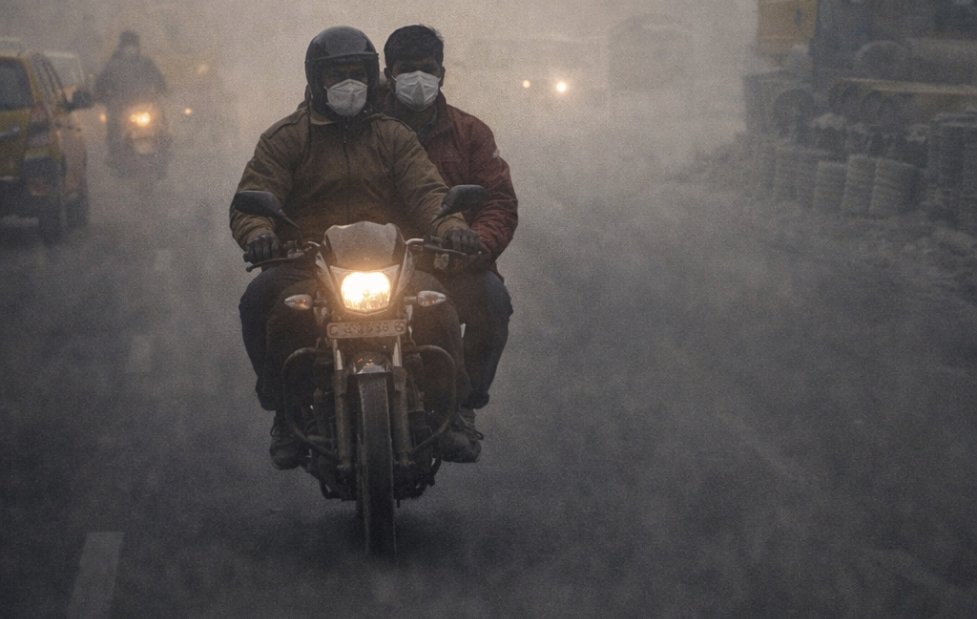
Every winter, a familiar grey blanket settles over North India. Flights are delayed, highways turn dangerous, and daily life slows to a crawl. While fog has always been part of the region’s cold season, scientists now say it is no longer just a weather phenomenon it is increasingly pollution-driven.
New research and meteorological observations show that air pollution is making winter fog denser, more persistent, and harder to disperse, especially across Delhi, Punjab, Haryana, western Uttar Pradesh, and parts of Rajasthan.
What was once short-lived morning fog is now turning into all-day smog-fog hybrids, lasting for days and sometimes weeks.
Why Winter Fog Is Getting Worse?
Fog forms when water vapor condenses into tiny droplets near the ground under cold and calm conditions. However, pollution has dramatically changed how this process works.
Scientists explain that pollutants act as condensation nuclei, meaning they give moisture something to cling to.
Key contributors include:
- Fine particulate matter (PM2.5 and PM10)
- Sulphates and nitrates from vehicle emissions
- Industrial pollutants
- Biomass and stubble-burning smoke
- When these particles accumulate in winter’s stagnant air, they trap moisture, leading to thicker and more opaque fog.
- This pollution-enhanced fog is often referred to as “smog-fog” or “smoggy fog.”
- The Role of Winter Weather Patterns
- Meteorologists point out that North India’s winter climate naturally supports fog formation but pollution magnifies it.
Key winter conditions include:
- Low wind speeds
- Temperature inversion (cold air trapped near the ground)
- High humidity at night
- Reduced sunlight
- Under inversion conditions, pollutants cannot rise and disperse. Instead, they remain suspended close to the surface, allowing fog to persist well into daytime hours.
- In earlier decades, sunlight would usually clear fog by mid-morning. Now, due to heavy particulate loading, solar radiation struggles to penetrate, delaying dissipation.
- Why Fog Now Lasts Longer Than Before
Experts note three major changes:
Earlier onset Fog now appears as early as November instead of mid-December
Longer duration Many cities experience fog for 10–15 consecutive days
Reduced visibility Visibility often drops below 50 metres in severe episodes
In extreme cases, Delhi, Amritsar, Lucknow, and Chandigarh record near-zero visibility, disrupting airports and railways repeatedly throughout the season.
Transportation and Safety Impact
- Thick fog combined with pollution has severe real-world consequences.
- Hundreds of flights delayed or diverted every winter
- Train schedules thrown off by hours
- Highway accidents rise sharply due to poor visibility
- Emergency services face response delays
- Authorities often impose speed restrictions on expressways and issue advisories urging people to avoid early-morning travel.
Health Risks Multiply in Smog-Fog Conditions
- Pollution-driven fog is not just a visibility issue it is a serious public health hazard.
- When fog mixes with toxic particles, people inhale:
- PM2.5 deeply into the lungs
- Nitrogen oxides and sulphur compounds
- Carcinogenic pollutants
- Doctors report spikes in:
- Asthma attacks
- Bronchitis cases
- Eye irritation
- Chest tightness and breathlessness
- Children, the elderly, pregnant women, and those with heart or lung disease face the highest risk.
- Why North India Is Especially Vulnerable
- Geography plays a major role.
The Indo-Gangetic Plain acts like a natural basin, surrounded by the Himalayas in the north, which blocks wind flow. Pollutants released in cities, farms, and industries accumulate instead of dispersing.
Major pollution sources include:
- Vehicular emissions in urban centres
- Coal-based power plants
- Construction dust
- Crop residue burning in neighboring states
- Domestic heating using solid fuels
- Together, these create the perfect conditions for prolonged fog episodes.
Climate Change Is Making It Worse
- Climate scientists warn that changing climate patterns are intensifying winter stagnation.
- Warmer winters reduce atmospheric circulation, while fluctuating humidity increases moisture availability both of which strengthen fog formation when pollution is present.
- This means future winters could see even denser and longer fog events, unless emissions are significantly reduced.
What Experts Say
- Meteorologists emphasize that fog itself cannot be controlled but pollution can.
- “Fog becomes dangerous only when pollution loads are high. Clean air allows fog to dissipate naturally,” experts explain.
- Without emission reduction, technological solutions alone cannot fix the problem.
What Can Be Done
- Experts recommend a multi-layered response:
- Strict control of vehicular emissions
- Accelerated transition to clean energy
- Effective management of stubble burning
- Dust control at construction sites
- Real-time pollution monitoring and forecasting
- Several cities are now experimenting with early warning systems that combine pollution and weather data to predict severe fog days in advance.
The Bigger Picture
- Winter fog in North India is no longer just a seasonal inconvenience it has become a visible symptom of chronic air pollution.
- Each year, the fog grows thicker, lasts longer, and causes greater disruption, reminding millions that environmental neglect carries daily consequences.
- Unless air quality improves substantially, experts warn that North India’s winters will continue to blur literally under a toxic mix of cold, moisture, and pollution.
- What once lifted with the morning sun now lingers through the day, turning winter fog into a lasting public health and climate challenge.




.png)