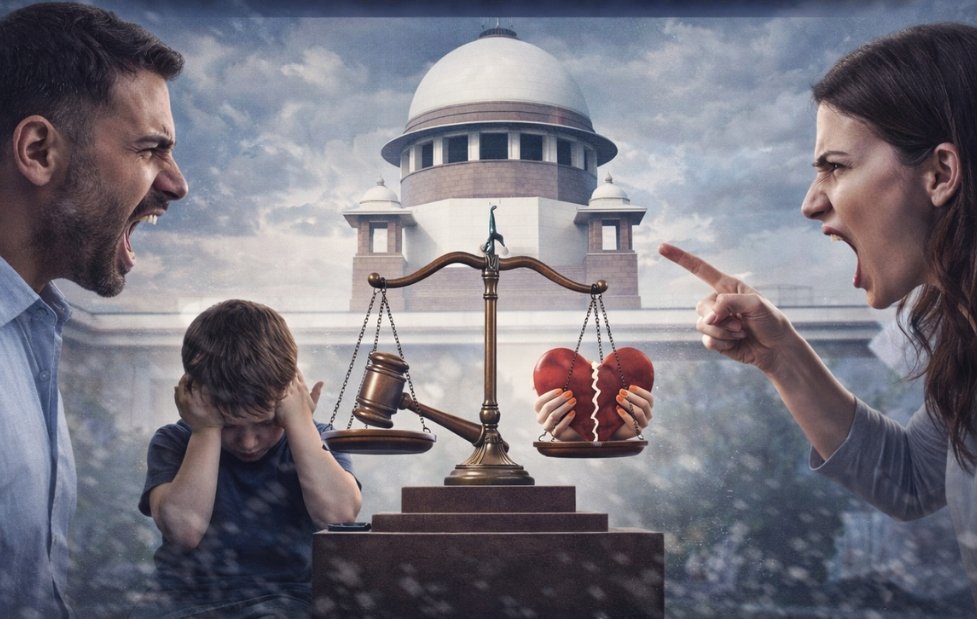
The Supreme Court has delivered a sharp reminder to estranged couples who transform matrimonial disputes into prolonged legal warfare: courts are not arenas for settling personal scores. In a strongly worded observation, the apex court cautioned that repeated and retaliatory litigation between spouses not only clogs the justice system but also deepens emotional damage for everyone involved especially children.
The ruling comes amid a rising trend where broken marriages spiral into years of criminal and civil cases filed across multiple courts, often with the intent to harass rather than resolve.
Courts Are for Justice, Not Vengeance
The Supreme Court noted that many matrimonial disputes today evolve into legal vendettas, where one case triggers another dowry complaints followed by defamation suits, maintenance petitions countered by custody battles, and endless appeals filed only to exhaust the other party.
The bench observed that litigation is increasingly being used as a tool of pressure rather than a path to justice.
“The legal system cannot be permitted to become a weapon of revenge,” the court remarked.
The judges stressed that while the law must protect genuine victims, misuse of judicial processes undermines faith in justice and delays relief for those with legitimate grievances.
Multiplicity of Cases Harms the Justice System
The court expressed concern over couples filing identical or overlapping cases in different jurisdictions sometimes simultaneously in family courts, magistrate courts, and high courts.
Such tactics, the bench said, result in:
- Judicial overload
- Conflicting orders
- Emotional and financial exhaustion
- Years of unresolved conflict
The Supreme Court warned that this “litigation marathon” serves no purpose except prolonging hostility.
Children Pay the Heaviest Price
A major focus of the court’s remarks was the impact on children caught between feuding parents. Judges noted that prolonged court battles often turn children into emotional hostages, exposed to bitterness, manipulation, and instability.
The court emphasized that parental responsibility does not end with marital breakdown.
“Children should not become collateral damage in a failed relationship,” the bench observed.
The ruling underlined that vengeance-driven litigation often harms children far more than the spouses themselves realize.
Mediation Over Hostility
Reinforcing earlier rulings, the Supreme Court strongly advocated mediation and amicable settlement in matrimonial disputes wherever possible.
The bench urged:
- Early mediation before escalation
- Family court–led reconciliation efforts
- Time-bound settlements to prevent endless litigation
Judges observed that not every broken marriage needs to end in courtroom combat, and dignity must guide separation when reconciliation is impossible.
Misuse of Laws Under Scrutiny
Without undermining the importance of protective laws, the court reiterated that misuse of matrimonial statutes including criminal provisions must be checked.
The bench warned that filing false or exaggerated complaints damages the credibility of laws designed to protect vulnerable spouses and diverts attention from genuine cases of abuse.
At the same time, the court clarified that its observations should not discourage legitimate victims from seeking justice.
A Message for Litigants and Lawyers Alike
The ruling also served as a subtle message to legal practitioners. The court emphasized that lawyers must guide clients toward resolution not fuel conflict for prolonged litigation.
Encouraging reconciliation, mediation, or dignified closure, the bench said, reflects both professional responsibility and constitutional values.
What This Means Going Forward
The Supreme Court’s observations are likely to influence:
- Family court proceedings
- Bail and quashing petitions in matrimonial cases
- Judicial emphasis on mediation before trial
More importantly, it reinforces a principle often forgotten in emotional conflicts: winning a case does not always mean winning in life. At its core, the Supreme Court’s message is clear justice is not revenge, and courts are not instruments of emotional retaliation. In an era where personal conflicts increasingly spill into legal arenas, the ruling calls for maturity, restraint, and humanity. When relationships fail, the law can help provide closure—but turning the judiciary into a battlefield only multiplies pain. For warring couples, the lesson is unmistakable:
Let the courts deliver justice not become tools to prolong suffering.

.png)