

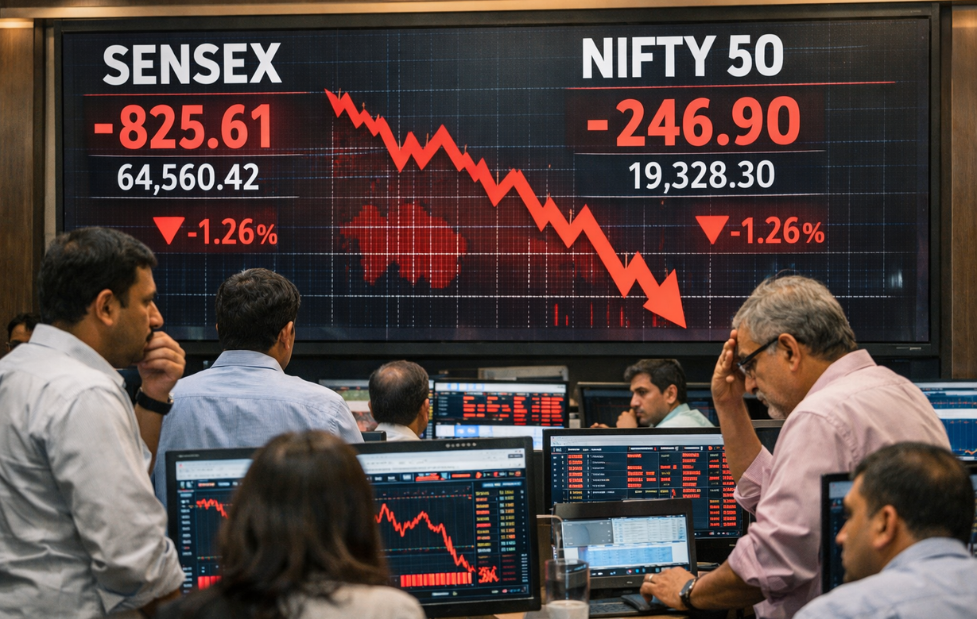
India’s benchmark equity index, the BSE Sensex, fell more than 800 points in Tuesday’s session, mirroring weakness across global markets and a sharp selloff in information technology stocks. The decline also pulled down the Nifty 50, reflecting widespread risk aversion among investors amid concerns over international trade policies, currency movements, and the long-term impact of artificial intelligence on outsourcing-driven business models. The downturn highlights the sensitivity of emerging markets to external economic signals and sector-specific disruptions.
What the Decision Means- The market fall underscores the heavy influence of technology stocks on India’s equity performance. IT companies generate a significant portion of their revenues from overseas clients, particularly in North America and Europe, making them vulnerable to global economic uncertainty and currency volatility.
Recent concerns about artificial intelligence reducing demand for traditional IT services have added another layer of uncertainty. Analysts note that while AI adoption presents long-term opportunities, it may also accelerate pricing pressure and business model changes in the near term.
For domestic investors, the decline serves as a reminder of market concentration risks, where sector-specific corrections can significantly impact broader indices. Businesses dependent on equity financing may also face short-term valuation pressures if volatility persists.
The Legal/Political Angle- Global trade developments have played a role in shaping investor sentiment. Policy signals around tariffs and protectionist measures in major economies can directly affect export-oriented sectors such as information technology, pharmaceuticals, and manufacturing.
Domestic policy stability remains relatively intact, but investors continue to monitor government decisions related to capital gains taxation, fiscal spending, and regulatory reforms. Political clarity typically supports market confidence, while uncertainty even if external can trigger portfolio rebalancing by institutional investors.
Regulators may also observe market volatility for signs of systemic risk, although current movements appear to reflect sentiment shifts rather than structural financial instability.
Impact on Bilateral/Global Relations- India’s stock market is closely linked to global capital flows, with foreign institutional investors (FIIs) playing a major role in liquidity and price movements. Any shift in global risk appetite particularly due to interest rate expectations in advanced economies can lead to capital outflows from emerging markets.
Trade tensions between major economies also indirectly affect India by influencing currency markets, export demand, and supply chains. A stronger US dollar, for example, can pressure emerging market currencies and trigger portfolio adjustments by international investors.
Despite short-term volatility, India’s long-term growth narrative driven by demographics, digitalization, and infrastructure investment — continues to attract global interest.
Market and Investor Reactions- Market participants responded cautiously, with investors rotating toward defensive sectors such as consumer goods and pharmaceuticals while reducing exposure to technology and high-valuation stocks. Banking shares also experienced mixed performance as concerns about global growth weighed on sentiment.
Foreign investors were reportedly net sellers during the session, contributing to downward pressure. Domestic institutional investors, including mutual funds and insurance companies, provided partial support but could not fully offset the selloff.
Volatility indicators rose, suggesting heightened uncertainty in the near term. Analysts emphasize that corrections are a normal part of market cycles, particularly after periods of strong rallies.
The Bottom Line- The sharp decline in the Sensex reflects a combination of global uncertainty, sector-specific concerns in information technology, and shifting investor sentiment rather than a single triggering event. While near-term volatility may persist, the broader market trajectory will depend on corporate earnings trends, global economic conditions, and policy stability.
For investors, the episode highlights the importance of diversification and long-term perspective, as markets continue to navigate structural changes driven by technology and geopolitics.

.jpg)


2.jpg)
2.jpg)
2.jpg)
1.png)
2.jpg)
4.jpg)