

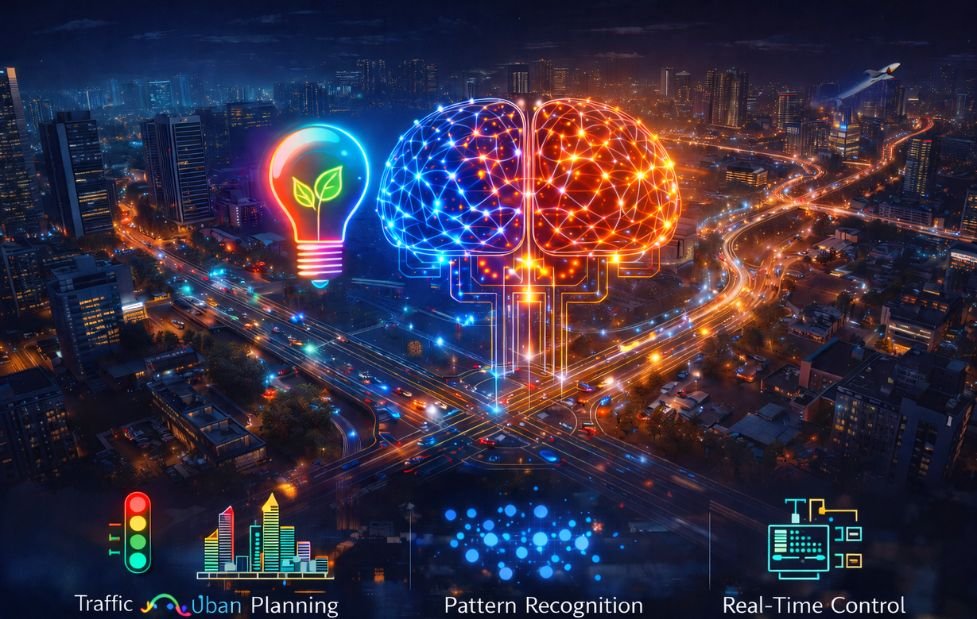
Researchers have unveiled a radical new idea that could transform how artificial intelligence is built and powered: using complex real-world systems like city traffic networks as physical computers. The approach aims to perform computation by harnessing naturally occurring dynamics instead of relying on energy-hungry data centers, potentially slashing the massive electricity demands of modern AI.
As global AI usage explodes, driven by data centers, generative models, and automation, energy consumption has become one of the technology’s biggest bottlenecks. This new concept offers a striking alternative—letting the physical world do the computing.
The Core Idea: Computing Without Computers
Traditional AI relies on silicon chips processing billions of operations per second. The new approach flips that logic entirely.
Instead of simulating complex systems digitally, researchers propose using the system itself to compute.
In this framework:
- Traffic flow becomes a computational network
- Cars act like data signals
- Intersections behave like logic gates
- Congestion patterns represent information processing
By observing how traffic naturally responds to changes such as accidents, light timing, or route shifts researchers can extract meaningful computational outputs.
This method is rooted in a concept known as physical reservoir computing.
What Is Reservoir Computing?
Reservoir computing is a type of machine learning where:
- A complex system (“reservoir”) transforms inputs naturally
- Only the final output layer needs training
- The internal system remains unchanged
What makes it powerful is that the reservoir doesn’t have to be digital.
Previous experiments have used:
- Water waves
- Mechanical vibrations
- Optical systems
- Electronic circuits
The new research shows that urban traffic networks can function as reservoirs too with no added hardware.
Why Traffic Networks Work So Well
City traffic systems have several properties ideal for computation:
- Highly nonlinear behavior
- Strong sensitivity to inputs
- Memory of past states (traffic jams persist)
- Continuous real-time evolution
These are exactly the features AI systems need to detect patterns and make predictions.
Researchers demonstrated that by adjusting inputs such as signal timings or vehicle flow they could encode information and read out computational results based on traffic behavior.
In essence, the city becomes a living processor.
Massive Energy Savings Potential
The most compelling benefit is energy efficiency.
Modern AI models require:
- Vast GPU clusters
- Continuous power and cooling
- Data centers consuming as much electricity as small cities In contrast, physical computing systems:
- Use energy the system already consumes
- Require minimal additional computation
- Eliminate most digital processing overhead
Since traffic already exists and already consumes energy, using its dynamics for computation adds almost no extra energy cost.
This could reduce AI energy usage by orders of magnitude for certain tasks.
What Could This Type of AI Be Used For?
The approach is not meant to replace ChatGPT-style models, but it could excel at specific problems, including:
- Traffic prediction and optimization
- Urban planning simulations
- Pattern recognition in complex systems
- Real-time control problems
- Smart city management
Ironically, traffic computing could be used to improve traffic itself creating a self-optimizing feedback loop.
A Shift Away From Silicon Dependency
The research comes amid growing concern that AI’s growth is becoming unsustainable.
Data centers now account for:
- Rising national electricity demand
- Increased carbon emissions
- Water shortages for cooling
- Infrastructure strain
Physical computing offers a new direction one where intelligence emerges from interaction with the real world, not just faster chips.
It also reduces dependence on rare materials and expensive hardware manufacturing.
Challenges Still Remain
Despite its promise, the idea faces limitations:
- Computation is slower and less precise than digital systems
- Traffic systems are noisy and unpredictable
- Results vary with weather, human behavior, and infrastructure
- Scaling beyond specialized tasks is difficult
Researchers stress that this is complementary AI, not a universal replacement.
Still, even partial adoption could significantly reduce energy demand in certain applications.
A Broader Vision of Future AI
The study reflects a growing movement in artificial intelligence research:
- Moving beyond brute-force computation
- Embracing physics-based intelligence
- Designing systems that compute by evolving naturally
Instead of forcing the world into computers, this approach lets the world compute itself.
As one researcher noted, “We don’t always need faster processors sometimes we just need to listen to the systems already around us.”
With AI energy consumption projected to soar in the coming decade, innovation is no longer just about performance it’s about sustainability.
Turning city traffic into a computer may sound unconventional, but it highlights a powerful insight: intelligence doesn’t have to live inside machines alone.
It can emerge from the complex rhythms of the world itself.
If successful, this approach could help build an AI future that is not only smarter but far greener.




1.jpg)
3.jpg)
4.jpg)
3.jpg)
4.jpg)