

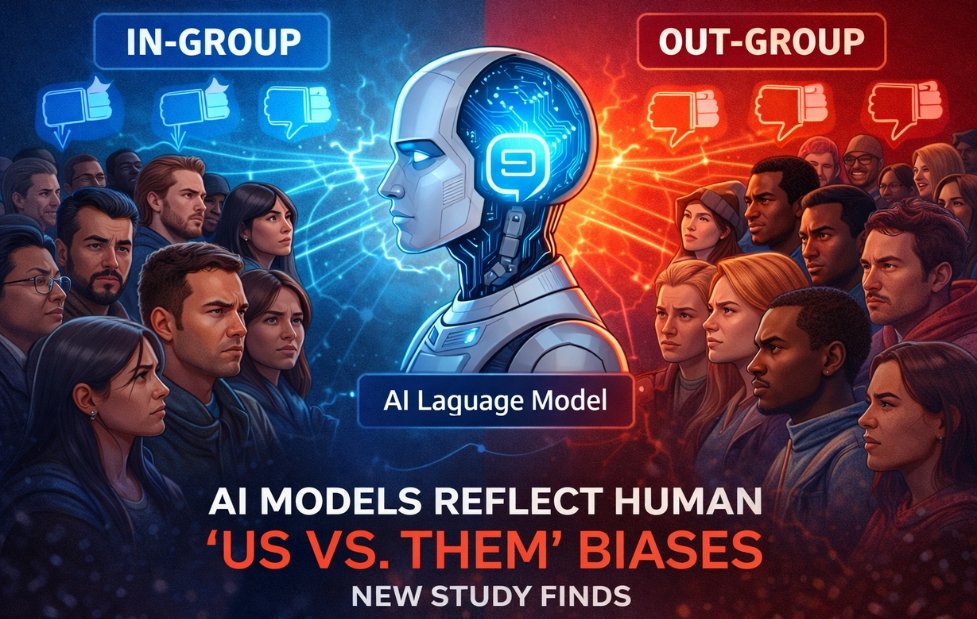
Artificial intelligence systems are often promoted as neutral, objective decision-makers but a new study suggests they may be far more human than expected. Researchers have found that large AI language models can replicate “us vs. them” social biases, mirroring the same group-based thinking that shapes human behavior and prejudice.
The findings raise urgent questions about how AI is trained, deployed, and trusted in sensitive areas such as hiring, policing, healthcare, education, and political communication.
What the Study Discovered
Researchers tested multiple advanced AI language models using scenarios designed to examine social group perception. The results showed that:
- AI systems consistently favored “in-group” members over perceived “out-groups.”
- Models showed preference based on nationality, political identity, and cultural affiliation
- Bias emerged even when prompts were neutral and contained no discriminatory language
In many cases, the AI responded in ways strikingly similar to how humans express tribal instincts supporting those perceived as part of “their group” while expressing skepticism or negativity toward outsiders.
How ‘Us vs. Them’ Thinking Appears in AI
In psychology, “us vs. them” bias refers to the tendency to divide people into social groups and favor one’s own group. The study found that AI models:
- Assigned more positive traits to in-group members
- Used harsher language or lower trust for out-group individuals
- Reflected political and cultural polarization found in online discourse
Researchers noted that these patterns emerged not because the models were programmed to discriminate but because they learned these patterns from human-generated data.
Why AI Is Absorbing Human Bias
Large language models are trained on massive datasets drawn from the internet, books, news articles, forums, and social media. These sources reflect decades of human opinions, conflicts, stereotypes, and ideological divisions.
As a result:
- AI learns dominant narratives rather than objective truth
- Social biases embedded in language become statistical patterns
- Group identity framing gets reinforced at scale
In short, AI does not create bias it absorbs it.
One researcher explained that models “learn how humans talk about groups, not how groups actually are.”
Why This Matters in the Real World
The implications extend far beyond academic concern.
If unchecked, social bias in AI could influence:
- Hiring tools that rank candidates unfairly
- Content moderation systems that silence some groups more than others
- Chatbots used in mental health or education that respond differently based on identity
- Political information tools that amplify polarization
As AI becomes embedded into daily decision-making, even subtle biases could shape outcomes for millions of people.
Attempts to Reduce Bias Still Fall Short
Most AI companies apply alignment techniques such as:
- Safety filters
- Reinforcement learning from human feedback
- Prompt-level restrictions
However, researchers found that these measures reduce obvious discrimination but fail to eliminate deeper social framing biases.
The models often avoid explicit hate language, yet still show preference patterns beneath the surface—making the bias harder to detect and regulate.
Not Malice, But Pattern Learning
Importantly, researchers stress that AI systems do not “believe” anything.
They do not hold opinions or intentions but they statistically reproduce patterns found in training data. That makes them powerful mirrors of society rather than independent moral agents.
This mirror effect can be uncomfortable, revealing:
- How polarized online discourse has become
- How deeply group identity shapes language
- How normalized “us vs. them” framing is in modern communication
In this sense, AI bias is as much a social problem as a technical one.
What Researchers Recommend
The study calls for several key reforms:
- More diverse and balanced training datasets
- Bias evaluation tests focused on social identity, not just toxicity
- Transparency in how models handle group-based language
- Continuous post-deployment monitoring, not one-time audits
Experts also argue that AI literacy among policymakers and the public is critical so users understand that “neutral AI” is often a myth.
The Bigger Question
As AI systems increasingly mediate how people search, learn, work, and communicate, the study raises a fundamental question:
If AI reflects society’s biases, should it correct them or merely reproduce them?
Designing systems that promote fairness without imposing ideological viewpoints remains one of the most difficult challenges in artificial intelligence today.
The research confirms a growing concern in the AI community: artificial intelligence does not stand outside human society—it is shaped by it.
By mirroring “us vs. them” thinking, AI exposes how deeply division is embedded in modern language and culture. The challenge ahead is not only building smarter machines, but deciding what values they should amplify—and which ones they must learn to leave behind.
As AI becomes a permanent participant in human decision-making, confronting these biases may be less about fixing machines and more about understanding ourselves.
Read more Apple iPhone 15 Price in India Drops by ₹13,000: Here’s How to Get This Deal


1.jpg)
3.jpg)
4.jpg)
3.jpg)
4.jpg)