

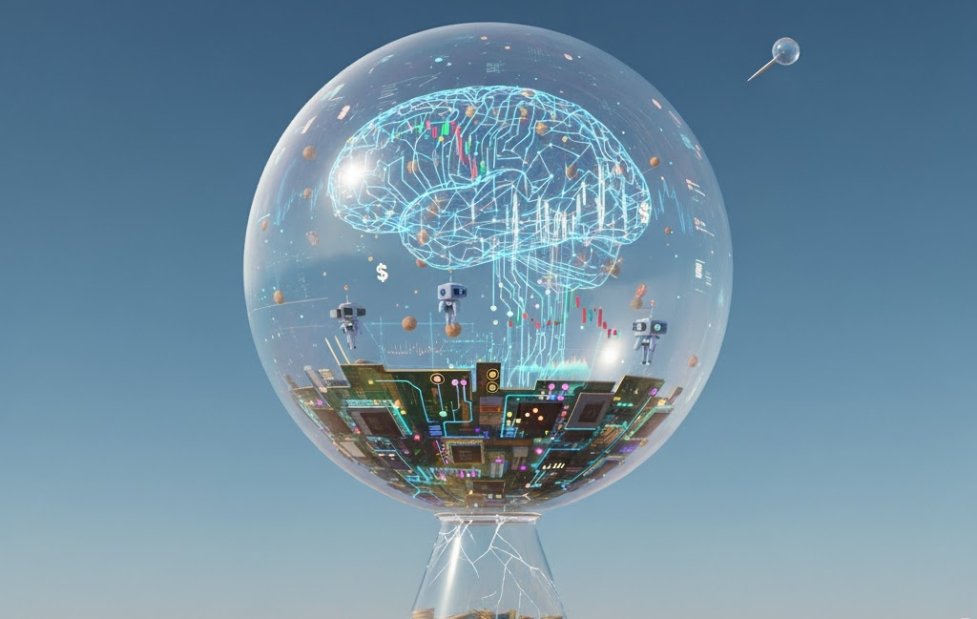
Why Concerns About an AI Market Bubble Are Growing
Business and technology analyst Erik Gordon has warned that the artificial intelligence boom may be creating what he describes as a “Jupiter planet-like” financial bubble—large, influential, and potentially unstable. Gordon highlighted how rapid investments, soaring valuations, and aggressive competition among tech companies could create unsustainable market expectations.
The warning comes at a time when artificial intelligence is attracting record funding and reshaping multiple industries.
How Microsoft Became a Key Example
Gordon pointed to Microsoft as a major example of how AI enthusiasm is reshaping corporate strategy and investor sentiment. Microsoft has invested heavily in AI technologies, integrating advanced tools into products, cloud services, and enterprise solutions.
The company’s aggressive AI expansion has helped drive market growth and investor optimism. However, Gordon cautions that when companies move quickly to dominate emerging technologies, financial expectations can sometimes outpace realistic returns.
Why AI Investments Are Expanding Rapidly
Artificial intelligence is seen as a transformative technology capable of improving:
- Business automation and productivity
- Data analysis and decision-making
- Customer service and software development
- Healthcare, finance, and manufacturing innovation
Because of this wide-ranging impact, companies across industries are racing to integrate AI into their operations.
What Creates a Technology Investment Bubble
Financial bubbles typically occur when investment excitement pushes valuations far beyond actual economic value. Experts say AI could face similar risks due to:
- Massive capital investment without immediate profitability
- Overestimation of short-term business transformation
- Market competition forcing companies into expensive technology adoption
- Investor fear of missing out driving inflated valuations
Such conditions can create unstable growth patterns.
Why Investors Are Paying Close Attention
The AI sector is attracting significant attention from global investors because it promises long-term technological transformation. However, Gordon emphasizes that history shows similar patterns in past technology booms, where:
- Early innovation generated strong excitement
- Investment expanded faster than business returns
- Market corrections followed once expectations stabilized
Examples from previous technology cycles have demonstrated how innovation can remain valuable even if investment bubbles eventually deflate.
How Companies Can Avoid AI Overinvestment Risks
Business analysts suggest that companies should:
- Focus on practical AI applications that deliver measurable value
- Avoid adopting AI purely for competitive image or marketing appeal
- Invest gradually while monitoring return on investment
- Balance innovation with financial sustainability
Strategic adoption reduces the risk of overdependence on emerging technology trends.
What This Means for the Future of AI Growth
Despite bubble concerns, experts agree that AI remains a powerful and long-term transformative technology. The challenge lies in balancing innovation with realistic financial expectations.
Companies that integrate AI responsibly and investors who evaluate long-term fundamentals rather than hype are likely to benefit most from the technology’s evolution.
The Takeaway
Erik Gordon’s warning about a potential “Jupiter-sized” AI bubble highlights the risks of excessive enthusiasm in rapidly expanding technology sectors. While companies like Microsoft are driving AI innovation and market excitement, experts caution that sustainable growth depends on practical applications and measured investment strategies.
Artificial intelligence is expected to reshape industries, but maintaining balance between innovation and financial discipline will determine its long-term success.





1.jpg)
3.jpg)
4.jpg)
3.jpg)
4.jpg)